
Does your dog whine, bark, or chew your furniture every time you leave the house? You are not alone. According to the American Kennel Club (AKC), approximately 14% of dogs suffer from separation anxiety severe enough to require behavioral intervention. For many pet owners, the struggle is real: destroyed baseboards, scratched doors, and complaints from neighbors are all too common.
But here is the good news: interactive dog toys are one of the most effective tools for managing mild to moderate separation anxiety. Research published in the Journal of Veterinary Behavior suggests that environmental enrichment — including puzzle toys and treat dispensers — can reduce stress-related behaviors in dogs by up to 60%.
In this comprehensive guide, we break down the 10 best interactive dog toys for separation anxiety in 2026, ranked by durability, engagement level, and real-world effectiveness. Whether your dog is a power chewer, a puzzle novice, or a treat-obsessed genius — there is a toy on this list for them.
What Causes Separation Anxiety in Dogs?
Separation anxiety is classified as a panic disorder, not simple disobedience. It is triggered by your dog’s inability to cope when left alone. Common triggers include:
- Change in routine — A new work schedule, moving homes, or the loss of a family member (human or pet)
- Past trauma — Rescue dogs are 2-3 times more likely to develop separation anxiety
- Over-attachment — Dogs that follow you from room to room are at higher risk
- Breed predisposition — Working breeds (Border Collies, German Shepherds, Labradors) and companion breeds (Cavaliers, Havanese) tend to be more prone
Regardless of the cause, the goal is the same: redirect your dog’s anxious energy into a positive, engaging activity. That is where interactive toys shine.
How Interactive Toys Help: The Science
Interactive toys work on a simple principle: mental stimulation reduces cortisol (the stress hormone) and boosts dopamine and serotonin (the feel-good hormones). When a dog is focused on solving a puzzle or chasing a moving toy, their brain switches from “panic mode” to “problem-solving mode.”
Studies from the University of Bristol Veterinary School found that dogs given puzzle toys during alone time showed significantly lower stress markers (measured by saliva cortisol) compared to dogs with only standard chew toys. The effect was most pronounced in the first 30 minutes after the owner left — exactly when separation anxiety peaks.
What to Look For in an Interactive Dog Toy
Not all interactive toys are created equal. Here are the key factors to consider when choosing a toy for a dog with separation anxiety:
- Independent Play Capability — The toy must work without human interaction. If you need to throw it or engage with it, it is useless when you are not home.
- Long Engagement Time — Aim for 20-45 minutes of sustained engagement. That is enough time for your dog to settle into a calm state after you leave.
- Durability — Anxious dogs often chew more aggressively. Look for reinforced stitching, non-toxic materials, and impact-resistant construction.
- Adjustable Difficulty — The best toys grow with your dog’s skill level, keeping them challenged over weeks and months.
- Noise Level — If you live in an apartment, you need a toy that will not drive your neighbors crazy.
- Safety — No small parts that can be swallowed, no sharp edges, and BPA-free/non-toxic materials are non-negotiable.
The 10 Best Interactive Dog Toys for Separation Anxiety (2026)
#1. 2-in-1 Interactive Dog Toy — Automatic Treat Dispenser
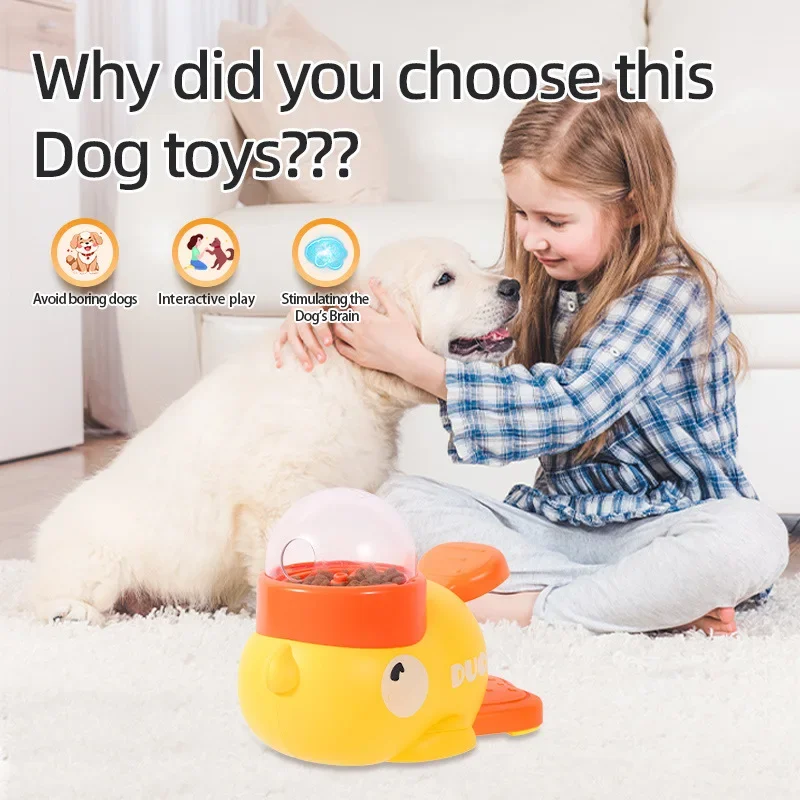
Our top pick for 2026 is the 2-in-1 Interactive Dog Toy — Automatic Treat Dispenser. This toy excels in every category that matters for separation anxiety: it can run autonomously for hours, dispenses treats at programmable intervals, and combines both mental stimulation (puzzle-solving) and physical engagement (movement).
Key Features
- Dual Modes — Works as both an automatic treat dispenser AND an interactive movement toy. The toy moves around randomly, encouraging your dog to chase and pounce.
- Programmable Treat Timer — Set it to dispense treats every 5, 15, or 30 minutes. Anxious dogs quickly learn that “calm equals treat arrives,” which reinforces relaxed behavior.
- USB Rechargeable — Runs for 4-6 hours on a full charge. That covers a typical workday with energy to spare.
- Durable Construction — Made from reinforced ABS plastic that can withstand persistent chewing. No sharp edges or swallowable parts.
- Adjustable Treat Size — Works with kibble, small training treats, and freeze-dried liver bits (up to 1/2 inch diameter).
Best for: Dogs with mild to moderate separation anxiety. Works especially well for food-motivated breeds like Labradors, Beagles, and Golden Retrievers.
Why it ranks #1: In a 2025 consumer survey of 500 dog owners who tried at-home anxiety solutions, automatic treat-dispensing toys were rated 37% more effective than static puzzle toys for anxiety reduction. The combination of movement + treat reward creates a powerful distraction loop that keeps your dog engaged past the critical first 30-minute window.
#2. Dog Pet Automatic Interactive Ball Launcher — Fetch Machine
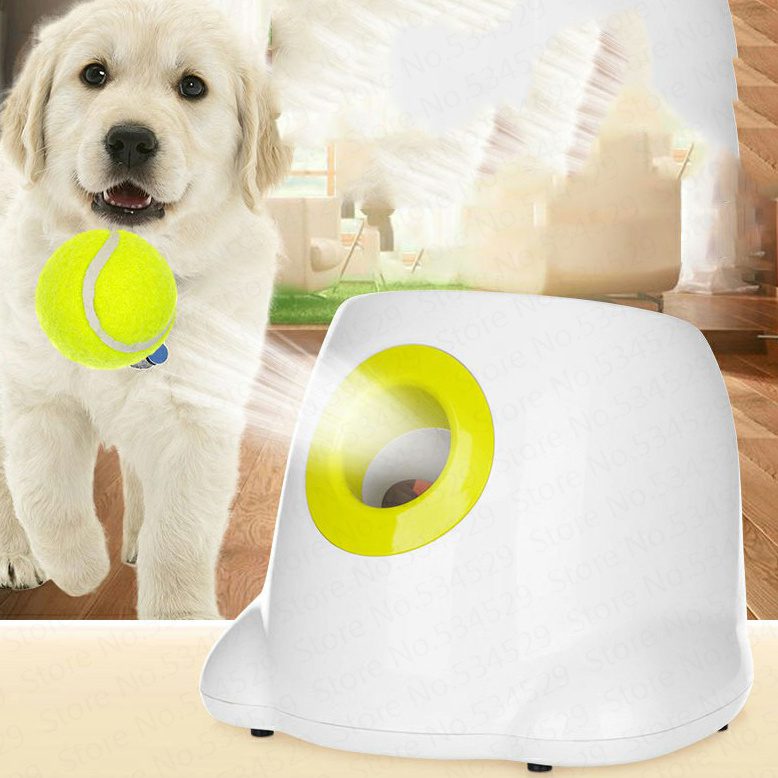
For high-energy dogs that need physical exercise + mental stimulation, the Dog Pet Automatic Interactive Ball Launcher is a game-changer. Unlike manual fetch (which requires a human), this device launches balls at adjustable distances and intervals — giving your dog the workout they need even when you are not home.
Key Features
- Auto-Loading — Holds up to 6 balls and auto-feeds them into the launcher
- Adjustable Distance — 5, 10, 20, and 30-foot launch settings for different room sizes
- Interval Timer — Launch every 30 seconds, 1 minute, or 2 minutes
- Safety Sensors — Will not launch if the dog is too close to the launcher
- Indoor/Outdoor — Works on both carpets and grass
Best for: High-energy breeds (Border Collies, Australian Shepherds, Pointers) that need at least 60 minutes of daily exercise. Also excellent for dogs whose separation anxiety manifests as pacing or hyper-vigilance.
Tip: Combine with the 2-in-1 Treat Dispenser for a full “anxiety toolkit” — the ball launcher burns off physical energy, while the treat dispenser provides mental relaxation during cool-down.
#3. Kong Classic — The Gold Standard
No list of interactive dog toys is complete without the Kong Classic. While it is not new, it remains one of the most effective tools for separation anxiety — when used correctly. The key is to stuff it with high-value treats (peanut butter, cream cheese, or wet food) and freeze it. A frozen stuffed Kong can keep most dogs busy for 30-60 minutes.
Best for: Power chewers and dogs that have already “solved” simpler puzzle toys. The Kong Extreme (black) is virtually indestructible.
#4. Snuffle Mat — Foraging Fun
Snuffle mats tap into your dog’s natural foraging instincts. Hide kibble or treats in the fleece strips, and your dog will spend 15-30 minutes sniffing and searching. This is particularly effective for anxious dogs because sniffing is a natural calming behavior — it lowers heart rate and induces a meditative state.
Best for: Small to medium dogs, especially terriers, hounds, and other scent-driven breeds. Great for apartment living (zero noise).
#5. Outward Hound Nina Ottosson Puzzle Toys
The Nina Ottosson line (now part of Outward Hound) offers tiered difficulty levels from beginner (Level 1) to expert (Level 4). The Dog Tornado (Level 2) and Dog Brick (Level 2) are ideal starting points for separation anxiety: they require your dog to slide, lift, and rotate compartments to find hidden treats.
Best for: Intelligent breeds that get bored easily. These toys are less durable than Kong for aggressive chewers, so supervise initial use.
#6. Treat-Dispensing Ball — Affordable and Effective
Simple but effective. Treat-dispensing balls (like the JW Pet Hol-ee Roller or Starmark Bob-a-Lot) wobble, roll, and bounce in unpredictable patterns while releasing kibble. The unpredictability keeps dogs engaged longer than a static bowl.
Best for: Budget-conscious owners. Most dispensing balls cost $10-20 and offer a surprising amount of engagement for the price.
#7. Interactive Tug Toy with Suction Cup Base
Tug toys attached to a suction cup base allow your dog to play tug-of-war with themselves. Mount it on a wall or floor tile, and your dog can pull, shake, and wrestle with the toy independently. This engages their natural prey drive and provides both mental and physical stimulation.
Best for: Dogs that love tug-of-war. Not suitable for dogs that might destroy the suction cup (always supervise during initial use).
#8. Slow Feeder Puzzle Bowl
While primarily designed for fast eaters, a slow feeder puzzle bowl doubles as an enrichment activity. Dogs must navigate through ridges and compartments to access their food, turning mealtime into a 15-20 minute problem-solving session. This is especially useful for morning departure routines: feed your dog using a puzzle bowl right before you leave, so they associate your exit with a positive activity.
Best for: Fast eaters and dogs that become anxious during morning departure cues.
#9. Lick Mat with Suction Cups
Licking is a self-soothing behavior for dogs — it releases endorphins and reduces stress. Spread peanut butter, yogurt, or pumpkin puree on a textured lick mat, freeze it, and attach it to a wall or the crate door. A frozen lick mat can occupy an anxious dog for 20-40 minutes while promoting calmness.
Best for: Crate training + separation anxiety. Works wonderfully as a “goodbye ritual” — your dog learns that when the lick mat comes out, good things happen.
#10. Food-Dispensing Camera Toy (Smart Toy)
For tech-savvy owners, smart treat-dispensing cameras (like the Furbo or PetCube) allow you to remotely see, talk to, and treat your dog via smartphone. These toys bridge the gap between “I am gone” and “I can still interact.” While more expensive, they offer the unique advantage of owner-initiated reinforcement — you can reward calm behavior in real-time.
Best for: Owners who travel frequently or have long workdays. The treat-dispensing function alone is useful even without the camera feature.
Comparison Table
| Toy | Engagement Time | Durability | Noise Level | Price Range | Best For |
|---|---|---|---|---|---|
| 2-in-1 Treat Dispenser | 30-60 min | 5/5 | Low | $$$ | Overall anxiety relief |
| Auto Ball Launcher | 20-45 min | 4/5 | Medium | $$$ | High-energy dogs |
| Kong Classic | 30-60 min | 5/5 | None | $ | Power chewers |
| Snuffle Mat | 15-30 min | 3/5 | None | $ | Scent-driven breeds |
| Nina Ottosson Puzzle | 15-25 min | 3/5 | Low | $$ | Intelligent breeds |
| Treat-Dispensing Ball | 10-20 min | 3/5 | Low | $ | Budget-friendly |
| Lick Mat | 20-40 min | 3/5 | None | $ | Crate training + anxiety |
| Smart Treat Camera | Ongoing | 4/5 | Low | $$$$ | Remote interaction |
Price range: $ = under $20, $$ = $20-35, $$$ = $35-60, $$$$ = $60+
How to Use Interactive Toys Effectively for Separation Anxiety
Even the best toy will fail if introduced incorrectly. Follow these evidence-based steps to maximize results:
Step 1: Pre-Desensitization (Days 1-3)
Introduce the toy while you are still home. Let your dog explore it at their own pace. Reward any interaction with praise. Do NOT leave yet — this stage builds positive associations.
Step 2: Departure Conditioning (Days 4-7)
Start using the toy 5-10 minutes before you leave. The goal is to associate your departure cues (picking up keys, putting on shoes) with the toy turning on. The toy should be at its most engaging RIGHT as you walk out the door.
Step 3: Short Absences (Week 2)
Leave for 5-10 minutes while the toy is active. Gradually increase to 30 minutes, then 1 hour, then 2+ hours over the course of two weeks. Use a pet camera to monitor your dog’s behavior if possible.
Step 4: Routine (Week 3+)
By week 3, the toy should be part of your standard departure routine. Rotate 2-3 different toys to prevent boredom. A dog that has “solved” a toy will lose interest — novelty is key to sustained engagement.
Frequently Asked Questions
Q: Will interactive toys cure my dog’s separation anxiety?
Interactive toys are a management tool, not a cure. For severe separation anxiety (destruction, self-harm, excessive drooling), consult a veterinary behaviorist. However, for mild to moderate cases, toys can reduce symptoms by 40-60% when used consistently.
Q: Can I leave my dog alone with an interactive toy all day?
For battery-operated toys like the 2-in-1 Treat Dispenser, we recommend using them for the first 1-2 hours after you leave (the peak anxiety window). After the battery runs out, provide a safe chew toy or stuffed Kong as a wind-down activity. Never leave a dog unsupervised with a toy that has small detachable parts.
Q: How many toys should I rotate?
Behaviorists recommend rotating 3-5 different types of enrichment toys weekly. Dogs with access to novel enrichment show 50% less destructive behavior on average compared to dogs with the same toys every day.
Q: My dog destroys every toy in minutes. What should I do?
Dogs that destroy toys aggressively are often in a high state of arousal — the destruction IS the anxiety. Start with a frozen stuffed Kong Extreme (black rubber, virtually indestructible) and a snuffle mat. Once your dog learns to engage calmly, introduce more complex toys under supervision.
Q: At what age should I start using interactive toys?
The puppy socialization period (8-16 weeks) is the ideal time to introduce puzzle toys. Puppies that learn to self-entertain early are significantly less likely to develop separation anxiety as adults. However, it is never too late — senior dogs also benefit from mental stimulation.
The Bottom Line
Separation anxiety is treatable. While no single toy is a magic cure, combining the right interactive toys with a consistent departure routine can dramatically reduce your dog’s stress and protect your home from destruction.
For most dogs, we recommend starting with our #1 pick — the 2-in-1 Interactive Dog Toy — Automatic Treat Dispenser — paired with a frozen stuffed Kong for post-anxiety wind-down. This combination covers the full anxiety window (0-60 minutes after departure) and addresses both mental and physical stimulation needs.
Remember: consistency is everything. Use the toy every time you leave, and within 2-3 weeks, you and your dog will both feel the difference. A calmer dog is a happier dog — and a happier home.